Understanding the 4D Scrappy ABM Framework: A Detailed Breakdown
Article at a Glance
What’s an ABM definition in simple terms?
At its core, ABM means focusing on the right accounts instead of everyone. You align Sales, Marketing, and Customer Success around a shared list, personalize your outreach, and run coordinated plays to win and grow those specific customers.
How do you implement account-based marketing without overcomplicating it?
Start with a repeatable system like the 4D framework:
- Data (who to target)
- Distribution (where to reach them)
- Destination (proof content)
- Direction (tracking and follow-up)
This keeps your ABM strategy practical and actionable.
What makes a good ABM campaign?
A strong ABM campaign starts with clear targeting, personalized outreach, relevant proof content, and tight tracking between Marketing and Sales.
Do you need special ABM services or software to run ABM?
Not always. Many teams use their existing CRM, email tools, and social channels. Yes, dedicated ABM services or platforms can help you scale, but you can start with what you already have.
Who is this account-based marketing approach best for?
It works best for B2B teams with defined ICPs, longer sales cycles, and higher contract values.
Spend a little time in the ABM world, and it can start to feel like you need a translator just to follow the conversation.
ABM. ABX. ABE. ABGTM.
Every week, there’s a new acronym that promises to reinvent your entire go-to-market motion. It’s enough to make you wonder if we’re doing marketing or just collecting Scrabble tiles.
But really, when you strip everything down, a good account-based marketing approach isn’t complicated. It’s just being intentional about four things.
Unfortunately, a lot of ABM campaigns get lost in jargon before they ever get off the ground. Teams debate tech and terminology while the fundamentals (like defining your ideal customer profile or aligning on a clear ABM strategy) get pushed aside.
At Scrappy ABM, we’ve found that simpler usually wins. Instead of adding more buzzwords, we use a straightforward system everyone can understand and execute. It’s something that supports demand generation instead of just good-looking slides.
Four steps. One repeatable system.
We call it the 4D framework.
Meet the 4D Framework
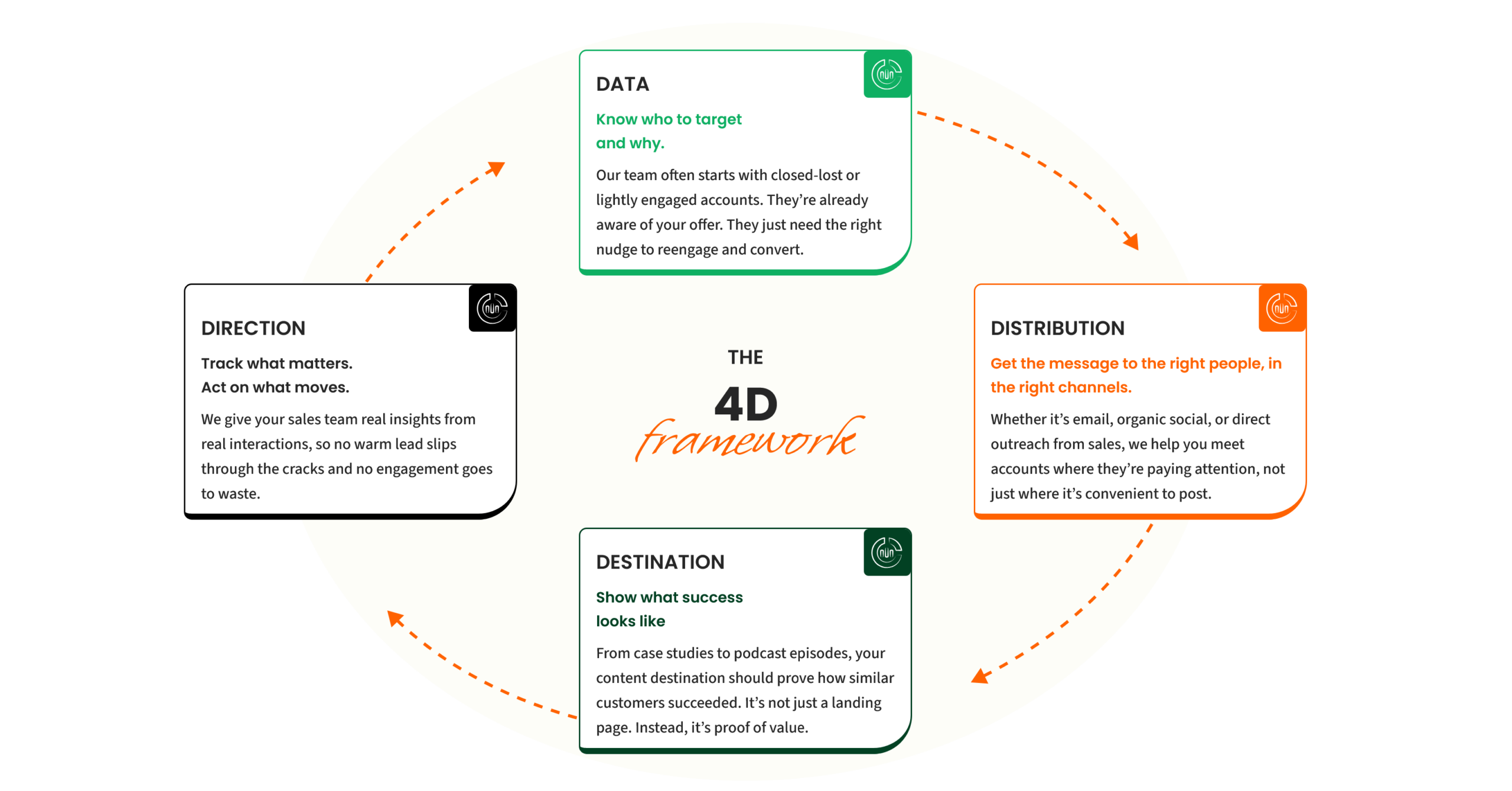
Once you strip away all the buzzwords, every successful account-based marketing approach comes down to the same few questions:
- Who are we targeting?
- How are we reaching them?
- What are we showing them?
- And how do we know it’s working?
That’s it. Not a massive software rollout. Not some complicated maze of platforms duct-taped together.
Just four simple decisions.
The 4D framework is the structure we use behind every ABM campaign we run. And it works regardless of your stack, because it focuses on behavior rather than tech.
Here’s the high-level view:
- Data → Know who to target and why
- Distribution → Get your message in front of them
- Destination → Show proof you can help
- Direction → Track signals and act fast
Because the goal of an account-based marketing approach isn’t to look impressive at a meeting. It’s to help Sales close more deals. The 4Ds make that practical.
#1: Data: Know Who to Target
Every effective ABM effort starts in the same place: clarity on who you’re going after.
Before you spin up new ideas or evaluate account-based marketing platforms, you need confidence that you’re pointing your effort at the right accounts.
And the great thing is that most of the answers you need are already sitting in your CRM.
Start with what you know:
- Which customers are the most profitable
- Which ones expand and stick around
- Which deals moved quickly and felt “easy” to win
- Which closed-lost accounts showed real intent but didn’t convert yet
That last group is one of our favorites. Closed-lost accounts already understand your solution. Timing or budget may have gotten in the way, but the awareness is there. Re-engaging them is often faster than trying to warm up completely cold accounts.
Your current CRM likely has everything you need to spot these patterns. Deal history, engagement, product usage, and past conversations tell a much clearer story than guesswork ever will.
This step isn’t about building the perfect list on day one but grounding your ABM strategy in evidence instead of opinions.
#2: Distribution: Meet Accounts Where They Already Are
After you know who to target, the next step in your account-based marketing approach is figuring out how you’re going to reach them.
This is where teams often overcomplicate things. They assume they need new channels or some elaborate structure to make progress. But distribution isn’t about doing more. It’s about being intentional.
You want to show up where your accounts already pay attention.
- That might be email.
- It might be direct outreach from Sales.
- It could also be sharing a relevant case study or podcast episode at the right moment.
The channel matters less than the context. Strong ABM campaigns feel personal and timely.
Instead of asking, “What new ABM platform should we add?” the better question is, “Where are our best accounts already engaging, and how do we meet them there?”
Most teams have what they need. The key is aligning Marketing and Sales around a repeatable strategy that uses those existing touchpoints more thoughtfully.
When distribution matches real buyer behavior, outreach feels natural. And when it feels natural, conversations happen faster.
Episode 65: The 4D Framework For Simplifying Your ABM Strategy
Dive deeper into the 4D framework so you can implement a simple structure to organize and launch an effective ABM program.

#3: Destination: Show Proof, Not Promises
You’ve got who you’re targeting and how you’ll reach them. Now there’s another question that often gets overlooked: Where are you sending them?
This is the Destination part of your account-based marketing approach, and it’s where a lot of otherwise solid ABM campaigns quietly drop off.
Too often, we do all this thoughtful targeting and distribution…and then drop people on a generic landing page that says, “We’re the best. Trust us.”
That’s not a destination. That’s homework.
In ABM, your destination shouldn’t feel like a pitch. Instead of broad, “about us” content, think:
- Case studies from companies that look like them
- Success stories that mirror their exact use case
- Podcast episodes featuring peers in their industry
- Tactical resources that help them solve a real problem
The goal isn’t to tell accounts how great you are but to show them what success looks like with you.
We’ve seen this play out countless times. Send someone to a polished but generic page, and engagement stalls. Send them to a story about a company just like theirs that solved the exact same problem, and suddenly the conversation feels obvious.
“Oh, this is for people like us.”
That’s the reaction you want.
#4: Direction: Track Signals and Act Fast
The last piece of the 4D framework is Direction, and it’s the one that turns everything else into results.
You can have great targeting, smart distribution, and strong content. But if no one follows up when accounts engage, your account-based marketing approach stalls out fast.
Direction is about paying attention to the right signals and acting on them quickly.
When a target account checks pricing or downloads a case study, that’s not just engagement. It’s a hand raise. And your ABM campaign should treat it that way.
The key is clarity:
- What counts as a meaningful signal?
- Who gets notified?
- How fast do we follow up?
Simplify those answers, and you become much more responsive. Sales reaches out while the account is still warm, then engagement actually turns into meetings.
Team Tip: Don’t Miss Your Window
“Most ABM programs miss because they waited too long to act on it. If an account hits pricing or multiple people engage in the same week, that’s your window. A quick, relevant follow-up within a day will outperform the perfectly crafted message two weeks later. In ABM, responsiveness is an advantage.”

Phil Pilalas
Content Strategist at Scrappy ABM
Why This Account-Based Marketing Approach Works
A lot of ABM advice makes it sound like you need a giant tech stack and six months of planning before you can even start.
Most teams don’t have that luxury. Which is why this account-based marketing approach works.
The 4D framework keeps things practical. Instead of trying to launch a complex ABM campaign all at once, you focus on four clear steps:
- Start with the right accounts
- Reach them where they already are
- Send them to proof, not promises
- Act fast when they engage
It also makes ABM much easier to explain internally. Sales understands it, Marketing can execute it, and Leadership can see how it ties directly to pipeline.
If you want help putting this into practice, we put together an ABM Program Planning Template that walks you through each step of the 4D framework. Grab it below to start mapping your own plan, and shoot us a message if you have any follow-up questions!

Mason Cosby
Mason is the founder of Scrappy ABM and a longtime believer that smart strategy beats shiny tools. He's sourced $25M+ in revenue, delivered 16x ROI, and helps teams do more with less through practical, personalized ABM.