How to Implement Account-Based Marketing
Article at a Glance
How do you implement account-based marketing?
Start simple. Define your best-fit accounts, align Sales and Marketing around one shared list, then run a few trigger-based plays. Most teams overcomplicate how to implement account-based marketing, but the best results come from repeatable abm marketing examples, like follow-ups to high-intent activity or personalized outreach to expansion accounts.
How much does account-based marketing cost?
Less than most people think. Your initial abm cost can be lower if you repurpose tools you already have (CRM, email, sales engagement). ABM is more about focus and coordination than buying new platforms.
How do you set your account-based marketing budget?
Instead of automatically adding budget, start by redirecting existing spend toward a couple of targeted named-account experiments. Use those tests to gauge pipeline impact, and slowly start scaling when you see results.
What are the best software tools for account-based marketing campaigns?
We get this question a lot. While strategic tech can help for sure, you don’t need special new tech to begin ABM. A CRM, basic reporting, and outbound tools could be enough to run early abm plays. Platforms can help you scale later, but tools should support your strategy.
What are common challenges in account-based marketing and how to overcome them?
Most teams struggle with targeting the wrong accounts, lack of alignment, and trying to launch everything at once. Solve this by focusing on your best customers, sharing ownership across teams, and starting with a few practical abm campaign ideas instead of a massive rollout.
If you’ve spent more than five minutes researching “how to implement account-based marketing”, it can start to feel…overwhelming.
You’ve probably seen plenty of new platforms, big budgets, and what feels like complex integrations.
Sometimes, it sounds less like a strategy and more like a full company transformation.
So most teams do one of two things:
- They either overbuild and stall for months
- Or they rush into campaigns and get zero results
And that’s why so many ABM programs fail.
It’s not because teams are bad at marketing. They just start in the wrong place.
One of the first abm marketing examples I think back on was my first attempt a number of years back: big list, automated outbound, pseudo-personalized pages. We targeted hundreds of accounts and expected meetings to roll in.
We got exactly zero.
The next attempt looked almost boring by comparison. We reused programs we already had, focused on a small set of best-fit accounts, and followed up with high-value outreach.
That “scrappy” version generated real pipeline fast (and the approach has generated $300M+ in pipeline to this day!).
The truth: Implementing ABM isn’t about buying more software. It’s about focus, alignment, and running a few repeatable plays well.
Below, we’ll walk through six steps, plus showcase a few practical abm marketing examples, so you can launch a program that works without rebuilding your entire tech stack.
Step 1: Define Your Best-Fit Accounts
If there’s one idea to take away from this whole guide, it’s this:
In ABM, your targeting is central to your strategy.
The accounts you choose determine whether everything else works or falls flat.
Most failed programs break because teams start with the wrong list. And we see the same three mistakes over and over.
First, there’s the “dream logo” list. Sales picks 200 companies everyone would love to close. They’ve got big names and big revenue.
The problem? You’ve never sold to anyone like them before. There’s no proof you can win those deals, so you spend months chasing accounts that were never realistic in the first place.
Second, there’s the giant ICP list. Aka, “anyone who fits our industry and company size.” Suddenly, your “account-based” program is 5,000 companies. That’s not ABM. That’s just lead gen with a spreadsheet.
Third, there’s what we call ICP + something random. You add a filter like “award winners” or “fastest-growing companies” and build your messaging around that theme. It feels clever, but it’s usually disconnected from who buys and sticks around.
Here’s the more reliable approach. Start with your existing customers.
Specifically, ask:
- Who is most profitable?
- Who renews and expands?
- Who gets the most value from what we sell?
- Who closes faster and is easier to support?
Those accounts are your blueprint. If you want better customers, go find more companies that look like your best ones.
Step 2: Align Sales and Marketing Around One Shared List
Once you’ve defined your best-fit accounts, the next step is making sure your team prioritizes them.
This is where a lot of ABM programs stall out. ABM gets handed to Marketing while Sales keeps doing business as usual.
If that happens, you don’t really have account-based marketing. You just have better targeting on the same ol’ campaigns.
A lot of teams think they’ve figured out how to do ABM when Marketing starts running ads or sending emails to named accounts. But if Sales isn’t focused on those same companies at the same time, the motion breaks. Follow-ups feel random, and momentum dies fast.
ABM works because it changes how teams prioritize their time.
Instead of Marketing generating activity and hoping Sales picks it up, both teams commit to the same list and move those accounts forward together.
That usually means getting clear on a few simple things upfront:
- One shared target account list everyone agrees on
- Clear ownership for follow-up (who reaches out and when)
- A shared definition of success (pipeline and revenue)
- A regular rhythm to review the progress together
None of this is fancy. It’s mostly operational. But it’s what makes ABM feel coordinated instead of chaotic.
Here’s a practical example.
Let’s say an account hits your pricing page three times in a week. In a traditional setup, Marketing might log the activity and move on. In an aligned ABM motion, Marketing flags the signal, Sales already knows the account matters, and a rep follows up with context while interest is high.
A small change, but the difference between a cold outreach and a warm conversation.
Get this alignment in place before you launch any big plays. It makes everything you run afterward more effective, because everyone is pulling in the same direction instead of running on parallel tracks.
Step 3: Start With Activation
Most people assume “implementing ABM” means launching a full, fancy program all at once—new tech, campaigns, processes, dashboards. It turns into a months-long project before anyone talks to a single account.
And momentum goes wayyyyy down.
Want a simpler way to approach how to implement account-based marketing? Start smaller than you think.
Don’t launch an extensiveprogram. Launch one repeatable play first.
At Scrappy, we call this activation.
Activation means responding to real buying signals you already have instead of trying to manufacture interest from scratch. It gives Sales a clear reason to reach out and creates conversations faster than broad campaigns ever will.
And the good news is you probably already have these signals sitting in your CRM or marketing automation platform.
While we could outline dozens of abm marketing examples here, why not start with a simple one:
- Someone books a meeting and no-shows
- A target account repeatedly visits your pricing or product pages
- A deal stalls after a demo
- A customer’s product usage spikes (great for expansion)
None of these require new software. You just decide: when this happens, we follow up this way.
For each trigger, define:
- Who reaches out
- What they reference
- What the next step should be
Now, Sales is reaching out with context. And Marketing is supporting real conversations already happening.
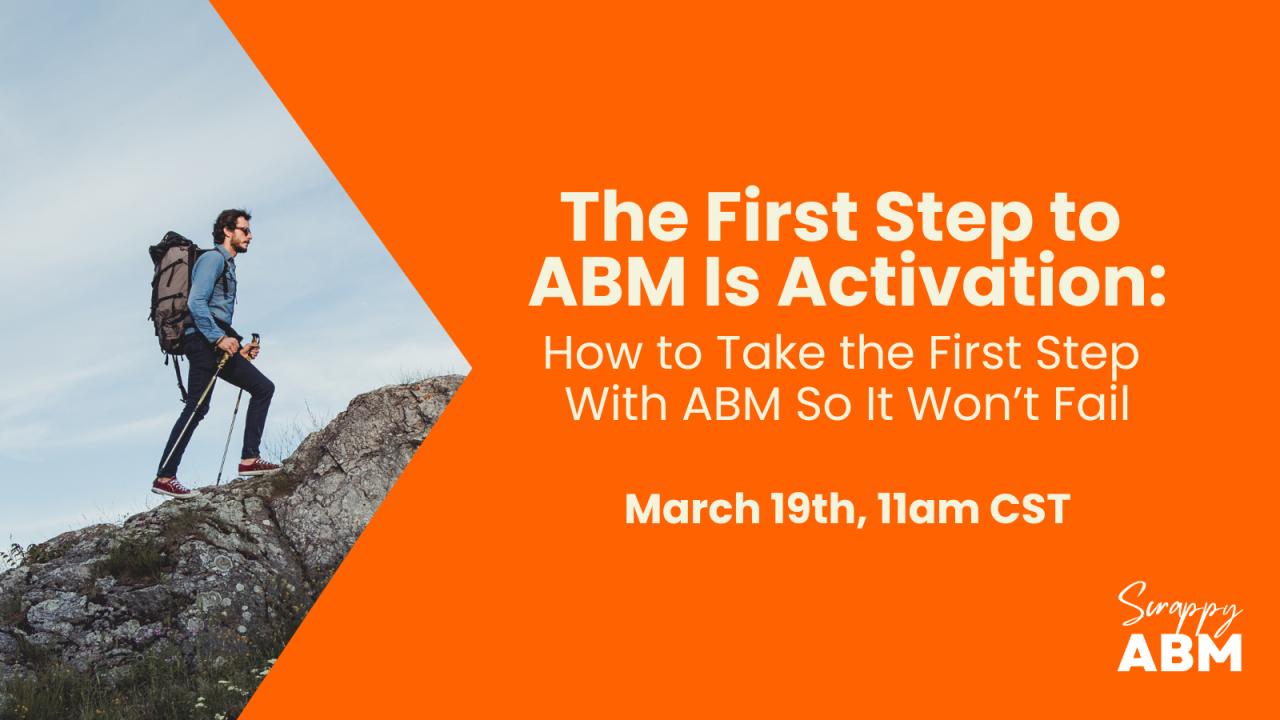
Recommended Resource: The First Step to ABM Is Activation
If you want your ABM program to be a smashing success, the first step after alignment is activation. This webinar breaks down what you need to do next to successfully activate your ABM program.
Step 4: Build 2-3 Simple Plays You Can Repeat
After you’ve had a few conversions come out of your first activation play, you might feel like hitting the gas and scaling up complexity.
But the real next step is to build consistency.
Remember this: ABM doesn’t win because it’s fancy. It wins because it’s repeatable.
You don’t need 25 tactics. You need two or three plays your team can run every week without thinking too hard about it.
For each play, keep it simple and answer the same questions:
- Who owns the outreach?
- What triggered it?
- What message or content supports it?
- What’s the next step you’re trying to book?
That structure keeps things from turning into random acts of marketing.
Here are a few more practical abm marketing examples that work well as repeatable plays:
- A short follow-up sequence for high-intent accounts
- A quarterly webinar or event promoted specifically to your target list
- A personalized audit or teardown for top-priority accounts
- A re-engagement play for stalled opportunities
- A light expansion play for existing customers
Notice these aren’t huge campaigns. They’re focused actions tied to specific moments.
The goal is to create a small library of proven plays your team can run consistently. Over time, those small touches compound into familiarity and trust (which is what actually moves deals forward).
Team Tip: Keep It Simple Enough to Ship
“ABM usually breaks when the plan looks great on paper but is too heavy to execute in real life. If a play requires five tools, three approvals, and a ton of custom work, it’s going to stall. I’d rather see two or three simple motions we can run every week than one ‘perfect’ campaign that never launches. Consistency beats complexity every time.”

Trevor Grimes
Content Strategist at Scrappy ABM
Step 5: Personalize Where It Matters
When it comes to ABM, personalization isn’t where you start, and it’s not what makes things work.
Relevance is. There’s a big difference.
Adding someone’s company name to a headline isn’t meaningful. Referencing something that actually happened (a meeting they booked, page they visited, problem they’re trying to solve) is.
The first one looks personalized. The second one feels helpful.
These abm marketing examples of good personziation are typically pretty simple and tied to real context:
- Following up after a missed meeting with, “Looks like timing got tricky. Want to reschedule?”
- Sending a short teardown of their homepage or ad strategy
- Sharing a resource specifically related to the industry they’re in
- Referencing a recent product launch or hiring push you noticed
One of the most effective abm marketing examples we’ve seen wasn’t scalable at all at first. It was a one-to-one website review recorded just for a single account. It took effort, but it was genuinely useful.
The mindset shift: personalize where it will change the conversation.
You don’t need to customize everything for everyone. Save the high-touch work for your highest-value accounts. Keep the rest lightweight and contextual.
If your personalization doesn’t make the buyer think, “Oh, this is helpful,” it’s probably just decoration.
Step 6: Add Budget + Tools Only After It Works
This might be the most counterintuitive part of implementing ABM.
Most teams assume tools have to come first.
They start researching platforms and booking demos before they’ve run a single play. Months go by configuring tech, and pipeline doesn’t move.
That’s backwards.
Tools don’t create ABM. They just make what’s already working easier to scale.
If you’re still figuring out how to implement account-based marketing, you don’t need a bigger stack. You need proof that your plays generate meetings and revenue.
In the early days, your existing setup is almost always enough. You can run plenty of effective abm marketing examples with the basics.
Once you have a few plays that consistently create pipeline, then it makes sense to ask:
- Where are we spending too much manual time?
- What would help us scale this faster?
- What data are we missing?
This approach also keeps your costs grounded in reality. Instead of guessing what you might need, you’re investing based on what’s already proven to work.
Start Small, Then Scale What Works
You probably noticed something by now: implementing ABM isn’t nearly as complicated as the industry makes it sound.
You don’t need to buy a platform or redesign your entire go-to-market motion to get started. Most teams already have the pieces in place.
Start small and double down on the efforts that create real pipeline. Everything else is just optimization.
If you want help turning these steps into a plan your team can execute, we put together an ABM Program Planning Template that walks you through the process. It’s the same framework we use with clients, and it’s designed to help you move from theory to action in one working session.
Grab the template, block time with your team, and build your first version. You can always refine it later. Getting started is what matters most!

Mason Cosby
Mason is the founder of Scrappy ABM and a longtime believer that smart strategy beats shiny tools. He's sourced $25M+ in revenue, delivered 16x ROI, and helps teams do more with less through practical, personalized ABM.