Why Account-Based Marketing Works (and Why You Should Try It)
Article at a Glance
Why account-based marketing works for B2B teams
Account-based marketing helps you focus on the accounts most likely to close, expand, and stay, instead of spreading effort across everyone and hoping it works out.
How does account-based marketing work in practice?
An account-based marketing approach aligns Marketing and Sales around a shared list of target accounts and measures progress at the account level (not just clicks, downloads, or form fills).
Is account-based marketing just another outbound tactic?
No. A strong ABM strategy coordinates multiple touchpoints across the buying committee and supports the full revenue journey.
Is account-based marketing more expensive?
It can increase cost per lead, but it tends to improve conversion rates, deal size, and retention.
Who should consider account-based marketing?
Mid-market and growth-stage teams looking for more predictable pipeline, stronger alignment, and a clearer path from marketing activity to revenue.
Account-based marketing usually doesn’t show up when everything feels perfect.
Pipeline exists, and on paper, things look fine. But behind the scenes…
- Sales is working way harder than they need to
- Win rates vary more than they should
- Marketing metrics don’t always translate cleanly into revenue
- And leadership keeps asking some version of, “Why does this feel so inconsistent?”
That’s when the conversation shifts toward a different question: why account-based marketing?
When you treat the entire market as equally important, you end up spreading your time, budget, and attention thin. Some accounts convert quickly while others stall. Some customers expand naturally, but others need constant convincing. And no one has fully stepped back to decide which accounts deserve the majority of your energy.
Account-based marketing works because it forces that decision. Instead of optimizing for reach, it asks you to define your best customers and build your motion around winning more of them.
It sounds simple. But in practice, it changes how your team prioritizes, how you measure progress, and how predictable growth feels.
Below, we’ll break down why account-based marketing works and when it makes sense to make the shift.
The Real Reason Why Account-Based Marketing Works
Teams asking why account-based marketing works expect the answer to be tactical. Stuff like…
- Better personalization
- Smarter automation
- More precise targeting
Those things help. But the real impact happens underneath the tactics.
It Changes What You Optimize For
Most growth engines are built around activity. The goal is to generate enough attention that revenue becomes the natural outcome of volume. If enough people see your brand, some will close. If enough campaigns run, some will perform.
An account-based marketing approach changes the scorecard.
Instead of asking how many people engaged, you start asking which accounts are progressing. Instead of optimizing for response, you optimize for movement inside specific companies. The conversation shifts from volume → and leads → accounts.
This change influences everything from budget allocation to campaign planning to how success gets reported in Leadership meetings.
It Prioritizes Accounts With Real Revenue Potential
In a lot of Marketing programs, every new contact begins at roughly the same starting line. Qualification happens later.
With account-based marketing, prioritization happens first.
You find the companies that resemble your strongest customers (the ones that retain, expand, and create meaningful value), and you build your motion around them. Marketing effort, Sales outreach, and executive attention flow in the same direction.
That improves both conversion rates and consistency.
It Creates Momentum Inside the Right Companies
B2B buying is rarely about a single email or contact. It’s about familiarity and credibility.
A well-executed ABM strategy intentionally builds that familiarity. Multiple touchpoints, multiple stakeholders, coordinated follow-up—these things all reinforce the same message within the company.
Over time, that creates momentum. Conversations feel less cold, and decision cycles get easier because the groundwork has been laid.
Account-based marketing doesn’t rely on hoping the right accounts find you at the right time. It builds structured momentum inside the accounts most likely to become long-term customers.
Who Should Try Account-Based Marketing?
Sadly, account-based marketing isn’t a magic button (though wouldn’t that be awesome?). It’s a strategic shift. And like any shift, timing matters.
Some teams are ready for it, but others need a bit more clarity first.
Here’s how to tell.
Teams With Traction, But Inconsistent Growth
If you already have pipeline and closed revenue, but results swing quarter to quarter, that’s a sign you’re operating on volume instead of precision.
An account-based marketing approach helps stabilize that motion by concentrating effort on accounts that look like your strongest customers. Instead of relying on broad demand to smooth things out, you build growth around the segments that already convert well.
Teams Whose Best Customers Look Similar
This is one of the clearest signals.
If your strongest customers cluster around certain industries, sizes, tech stacks, or buying triggers, you have something valuable: a pattern.
When patterns exist, an ABM strategy can amplify them.
Instead of spreading effort evenly across the market, you double down on the segments that retainand expand. That’s where account-based marketing tends to outperform broad campaigns.
Teams Ready for Practical Sales and Marketing Alignment
Many organizations say they’re aligned. Fewer operate that way day to day.
Account-based marketing works best when a team is ready to rally around a shared target list and measure success at the account level. That shared direction often gets rid of internal noise and sharpens execution.
Teams With Enough Data to Be Intentional
If every closed deal looks completely different and you’re still experimenting with who your product fits best, you miiiiight need more clarity before fully leaning into account-based marketing.
But if you can clearly see which customers stick around and create the most value, you’re in a good position.
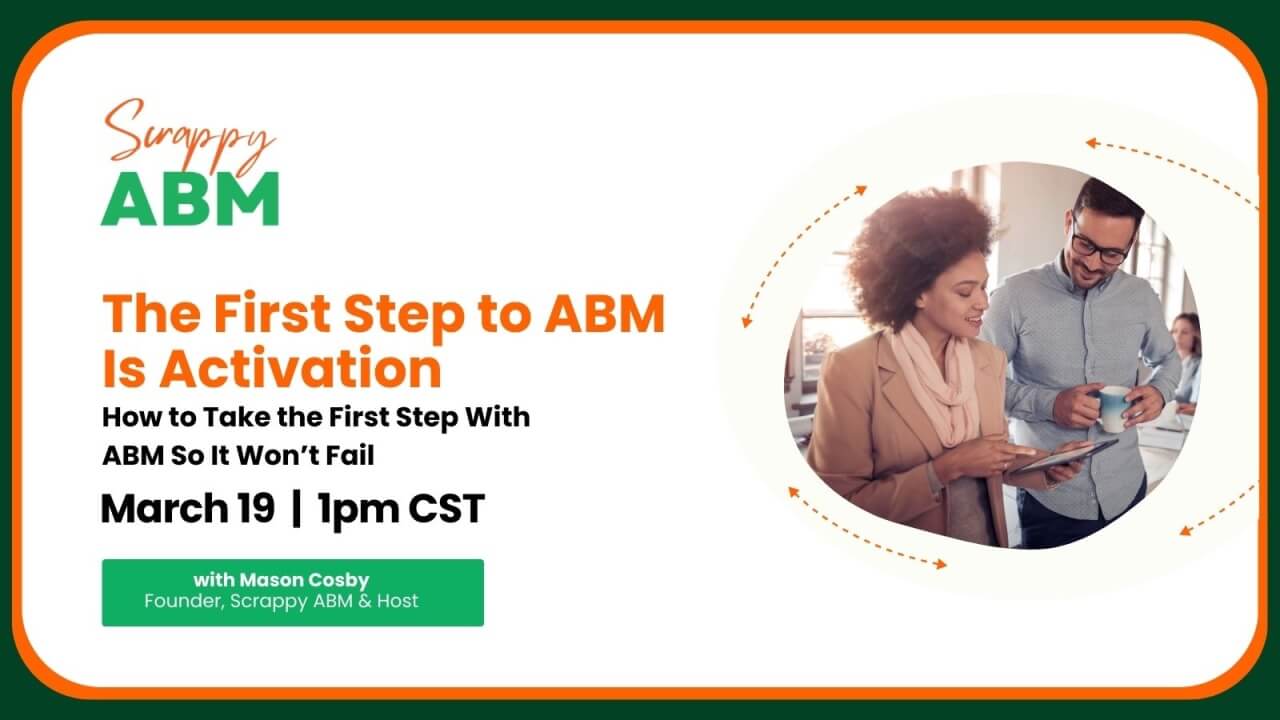
The First Step to ABM is Activation
Alignment is important, but activation is where results begin. Join Mason Cosby as he walks through the crucial first steps to launch an ABM program that turns strategy into measurable success.
Where to Go From Here
Account-based marketing works because targeting is the strategy.
The accounts you prioritize determine everything that follows—your messaging, outreach, budget allocation, and even how Sales spends their time. When that list is grounded in real customer data instead of ambition, the rest of the motion gets sharper.
But before you launch new campaigns or expand spend, map the motion intentionally.
Our ABM Program Planning Template walks you through defining your target accounts, aligning your revenue team, and structuring your account-based marketing approach around measurable business outcomes.
Grab it below and map your motion to the accounts most likely to love what you sell!

Mason Cosby
Mason is the founder of Scrappy ABM and a longtime believer that smart strategy beats shiny tools. He's sourced $25M+ in revenue, delivered 16x ROI, and helps teams do more with less through practical, personalized ABM.