The First Step of ABM is Activation
Article at a Glance
Why is activation the first step of ABM?
Because it lets teams start with real buying signals and conversations instead of big programs and long setup cycles. Activation creates momentum fast and builds confidence across teams.
What is an activation play in ABM?
It’s a trigger-based outreach play where a specific signal (like pricing page visits or missed meetings) tells Sales exactly who to prioritize and why.
Do I need new tools to run activation plays?
Usually no. Most teams can start using their existing CRM and sales engagement tools to find triggers and run simple sequences.
How does activation help Sales and Marketing alignment?
It gives both teams a shared reason to engage accounts, clear ownership of follow-up, and fast feedback on what drives meetings and pipeline.
Can activation support expansion, not just net-new deals?
Yes. Activation works just as well for customer growth triggers like product usage, renewals, and cross-sell opportunities.
When should teams move from activation to full ABM?
Once you see consistent results from triggers and handoffs, you can layer in account-level plays and deeper personalization with much less risk.
Most teams don’t struggle with ABM because they don’t want to succeed.
They struggle because ABM usually gets introduced like a full-body transformation:
- New strategy
- New tech
- New processes
- New expectations across Sales + Marketing
All at once. Yikes.
That’s a lot to ask from people who already have full-time jobs and quarterly numbers staring them down.
So what happens? Teams try to launch ABM the way it’s marketed, with a big platform and big rollout. Months go by building dashboards and workflows. Then the pressure hits. Where the heck is the pipeline?
Results don’t show up fast enough, and the program quietly becomes something your team experimented with instead of a growth engine.
Here’s the better approach: start with activation.
Not a massive ABM program or a tech overhaul. One trigger-based play using the data and tools you already have. Here’s how to do so.
What “Activation” Means in Scrappy Terms
When we talk about activation, we’re not talking about flipping on a new platform or rolling out a complex campaign.
We’re talking about starting with a simple play that helps your team know who to prioritize and why. It’s the difference between saying “these accounts fit our ICP” and saying “something just happened that makes this account worth reaching out to today.”
And the good news? Those triggers come from data you already have.
For example, things like:
- Someone booked a meeting but didn’t show up and never rescheduled
- An ICP-fit account spent time on key product or pricing pages, but didn’t convert
These are small moments, but they’re strong signals of interest. Activation just means noticing those moments and responding consistently.
From there, you turn that signal into a clear, repeatable play:
- Who should reach out and when
- What the message should reference so it feels relevant
- What the next step is after that first touch
Now, Sales isn’t being asked to change how they do everything overnight. They’re being supported with better timing and outreach that makes sense to the buyer.
That’s why activation works so well as a starting point. It creates early momentum and gives your team something concrete to improve together (before you ever try to scale into a full ABM program).
Examples of High-Intent Triggers You Can Use Today
A big misconception about activation is that you need a brand-new tech stack to get started.
Really, some of the best triggers are sitting in your CRM or marketing automation platform. You just need to decide which moments are worth acting on.
Here are a few high-intent signals teams can use right away:
1. Missed or stalled meetings
If someone booked time with Sales, that’s a strong buying signal. But if they missed the meeting or went quiet afterward, that interest didn’t disappear. It just stalled. Re-engaging with context (“saw we never got a chance to connect”) feels natural and helpful, not salesy.
2. Repeated visits to key pages
When an ICP-fit account is spending time on product pages, pricing, or demo content, they’re doing a real evaluation. Even without advanced website tools, you can often see this at the contact level once someone has filled out a form in the past.
3. Product usage milestones (for SaaS or subscription models)
Accounts that hit usage thresholds or invite more users signal readiness for new conversations. These triggers are gold for Customer Success and Sales working together.
4. Past buyers or engaged customers
If someone purchased once, attended an event, or used a trial, they’ve already raised their hand. Following up based on that prior interaction is way more effective than starting from zero.
The goal here isn’t to build the perfect list of triggers on day one. It’s to pick one or two signals that are easy to access and tied to real business conversations.
Once that first trigger is working, you can always layer in more. But starting simple is what gets you moving.
Team Tip: Use the Signals You Already Have
You don’t need a new tech stack to start activation. Some of the best triggers are already in your CRM or marketing tools.
A few easy places to start:
- Missed or stalled meetings
- Repeated visits to product or pricing pages
- Product usage milestones (for SaaS)
- Past buyers or previously engaged contacts
Pick one or two signals that are easy to access and tied to real conversations. Get that working first, then layer in more over time.

Amanda Palmarchuk
ABM Strategist at Scrappy ABM
How to Build an Activation Play
After you’ve picked a trigger, the next step is turning that signal into a repeatable play your team can run.
An activation play needs to answer three questions clearly:
Who should reach out?
Usually, this is a seller, an account manager, or sometimes Customer Success for expansion plays. The key is that it’s obvious who owns the follow-up, so the signal doesn’t just sit in a dashboard.
What’s the reason for the outreach?
This is where the trigger does the heavy lifting.
“Because you visited our pricing page three times” or “because you booked a meeting last week” is a much better reason to reach out than the ol’ “just checking in.”
What should they say or send?
Give the team a simple message or piece of helpful content that matches the moment. This keeps outreach consistent and saves reps from reinventing the wheel every time.
From there, you operationalize it with whatever tools you already have:
- A saved filter or report in your CRM
- A simple list that updates weekly
- A basic outbound sequence in your sales engagement tool
Marketing can help build the messaging and assets, while Sales owns the conversations. And now you’ve got a motion that runs without needing a giant ABM platform or a six-month setup.
Just be sure to run it consistently.
Weekly or monthly is enough to start. What matters is that the team sees real conversations and real meetings coming from it.
Want to Dive Deeper on Activation? Watch this Webinar
If you want your ABM program to be a smashing success, you need to focus on activation. Join Mason as he breaks down what you need to do next to successfully activate your ABM program.
Why Activation Creates ABM Buy-In
Activation is an awesome way to get lasting buy-in across teams.
When Sales starts seeing meetings come from clear signals, ABM starts feeling like something that supports how they already work. There’s a real reason to reach out and a clear message to send.
For Marketing, activation creates a direct line between what they build and what shows up on Sales calendars. Instead of measuring success only by clicks or engagement, they can see which triggers turn into conversations.
And for leadership, activation creates early proof. There are more meetings in the right accounts and fewer debates about whether the effort is worth continuing.
Once that trust is in place, it becomes much easier to add personalization across personas and stages.
In other words, activation lowers the risk of ABM.
Start Small, Prove Value, Then Scale
If there’s one idea to take away from all of this, it’s simple: You don’t have to build a complex ABM program on day one to get real results.
In fact, trying to do everything at once can slow teams down.
Starting with activation lets you use what you already have and focus on creating real conversations. You learn what messages resonate and how Sales and Marketing can support each other in practice.
From there, scaling ABM becomes a lot more natural.
You already have:
- Proof certain triggers lead to pipeline
- A working handoff between teams
- A clearer sense of where better data or tooling would help
At that point, ABM is the next logical step.
Want help mapping out what your first activation play and broader ABM program could look like? Grab our ABM Program Planning Template. It walks you through target accounts, triggers, plays, and handoffs so you can design a program that fits your team instead of forcing a copy-and-paste model.
Download it here and start building your first activation play!
In Case You Want More on Activation
Check out these resources.
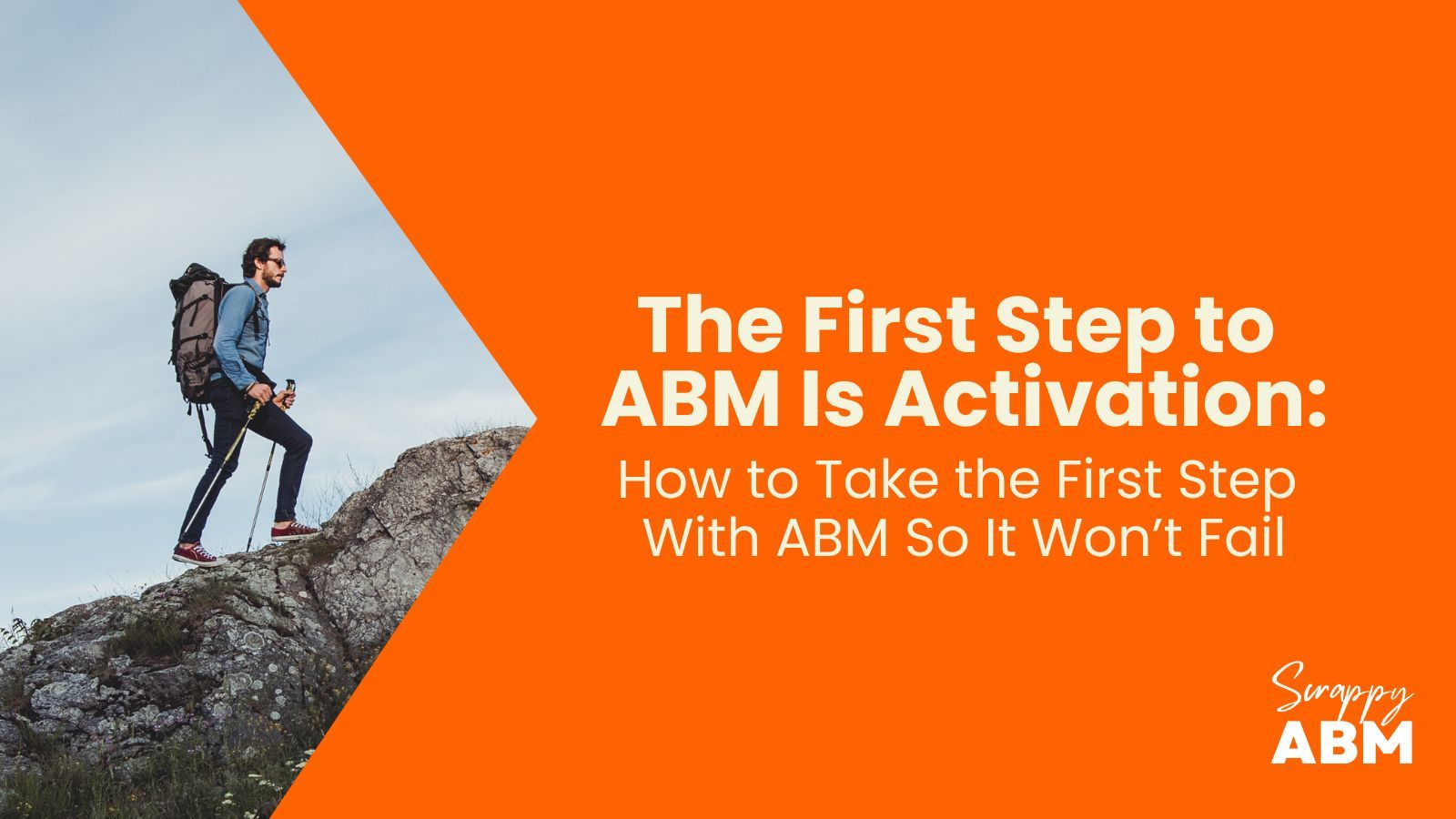
Webinar: The First Step to ABM Is Activation
Brand Building Vs. Sales Activation In ABM

Mason Cosby
Mason is the founder of Scrappy ABM and a longtime believer that smart strategy beats shiny tools. He's sourced $25M+ in revenue, delivered 16x ROI, and helps teams do more with less through practical, personalized ABM.